
In short: minimum living income Spain foreigners: the IMV (ingreso mínimo vital, a Social Security benefit for people and households with very low income) is not tied to nationality, since art. 10 of Law 19/2021 does not mention it, but it does require legal and effective residence in Spain, continuous for at least the year before you apply. Three groups do not need that year: minors who join the household, victims of human trafficking and sexual exploitation, and women victims of gender violence. You apply on the Social Security online office. In the Basque Country, Navarra and Catalonia the process is handled by regional bodies (Lanbide, UAT, OAC). The INSS has 6 months to decide; with no answer, the application is treated as denied.
In person or by representative? You do not need to visit an office: Social Security says you can apply online, with a certificate or Cl@ve, or with a form if you have neither. Another person with a certificate or Cl@ve can file it as your representative. In the Basque Country the process goes through Lanbide, in Catalonia through the citizen service offices (OAC) and in Navarra through the administrative processing units (UAT), with an appointment for in-person service (according to the Social Security online office).
Requirements
- One year of legal and effective residence. It must be continuous and uninterrupted during the year immediately before the application date, and it is required of every member of the household (art. 10.1.a, Law 19/2021). According to Social Security, stays abroad that do not exceed 90 days per calendar year do not break habitual residence. In its written reply (buzón de consultas, 19.10.2026), Social Security says the year counts «desde la fecha de resolución» (from the date of the decision). It adds: «siempre se tendrá en cuenta la fecha de resolución cuando haya solicitud de renovación» (the decision date will always be taken into account when there is a renewal application). It does not say whether the time with a renewal pending counts: if that is your case, ask the INSS.
- Exceptions to the year. Only three: minors who join the household by birth, adoption, family reunification of children, guardianship for adoption or permanent foster care; victims of human trafficking and sexual exploitation; women victims of gender violence. They still need legal and effective residence; only the year is waived. Asylum seekers and temporary protection are not named in that article.
- How legal residence is proved (art. 21). If you are from the EU, the EEA or Switzerland: registration in the Central Register of Foreigners. If not: an EU family member card or a residence authorisation of any kind. Victims of trafficking and of gender violence can use a provisional authorisation. The NIE serves to identify you (art. 21.1); residence is proved with the card or the authorisation.
- International protection and temporary protection. The law names neither, neither as an exception to the year nor as a valid document. According to the written reply from Social Security (buzón de consultas, 19.10.2026), for international protection applicants the year counts from the date they filed the asylum application, even if the decision granting it comes later. That reply says nothing about temporary protection (for example, people displaced from Ukraine), so we cannot say whether it counts or from when. Ask the INSS (phone 020) or a professional before counting on the benefit. Our cards: temporary protection and asylum.
- Income and assets. The household's average monthly income of the previous year must fall at least €10 below the renta garantizada (the income threshold set for your household). If your net assets, not counting your main home, reach €26,409.60 (single person, 2026), there is no economic vulnerability according to Social Security.
- Age and household. Single person: from age 23 and not married or in a registered partnership, unless separation or divorce has started. If you are under 30, you also need 2 years of independent living in Spain: an address different from your parents' or guardians' and at least 12 months, continuous or not, registered (alta) with Social Security in that period. From age 30, 1 year at an address different from your parents'. There are exceptions (art. 10.2). The household (unidad de convivencia) must have been formed for at least 6 months in a row, also with exceptions, such as a birth or being a victim of gender violence (art. 10.3). Victims of gender violence or trafficking, people aged 18 to 22 leaving a child protection centre or who are full orphans living alone, and people released from prison after more than 6 months have their own age rules (art. 4).
- 2026 amount. Single person: €733.60 a month. Two adults: €953.68. One adult with one minor: €953.68, or €1,115.07 if it is a single-parent household (one adult with sole custody of the minor). This is the renta garantizada: what you receive is the difference from the household's income, with a minimum of €10 a month. Full table in Social Security amounts.
- Work. The law declares it compatible with income from work or an economic activity if the conditions set by the rules are met (art. 11.4). We have not reviewed those conditions: ask the INSS before you start working.
- After you start receiving it. Report any change within 30 calendar days and give notice before a trip of more than 90 days a year. IMV recipients always file the tax return (card) and are exempt from pharmacy co-payment (card).
Documents
- Identity document: the one from your country, the foreigner card (TIE) or the passport, plus the NIE if it does not appear.
- Document proving your legal residence: EU family member card or residence authorisation.
- Certificate of empadronamiento (how to get it).
- Family book or birth certificate of the children, depending on the household.
- Income and asset data for all members, declared on the form.
- Signature of the applicant and of the adults in the household on the application.
- The list depends on the household and the situation; Social Security explains the proof on its applications page.
- If you have worked in Spain, you can review your registration periods with the vida laboral; the sources we reviewed do not list it as a required document.
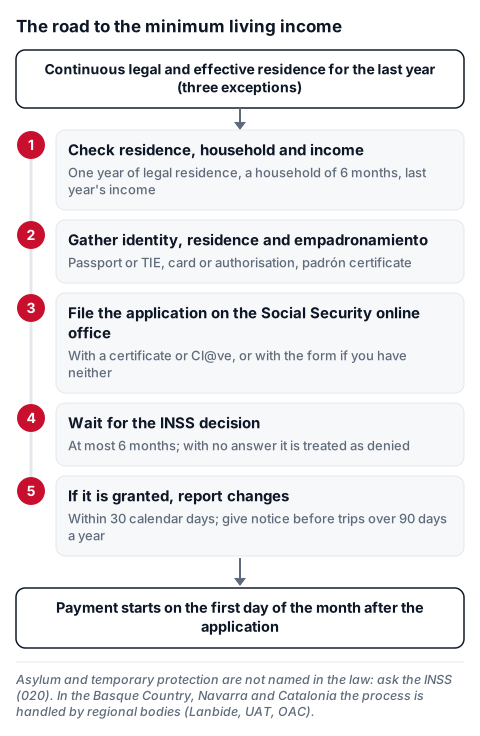
Steps
- Check your continuous legal residence over the last year, your household and last year's income. Social Security has a simulator at imv.seg-social.es.
- Gather identity, proof of legal residence and the empadronamiento of all members.
- File the application in the IMV service of the Social Security online office: with an electronic certificate or Cl@ve, or with the form if you have neither (how to get Cl@ve). In the Basque Country, Navarra and Catalonia the process is handled by regional bodies (Lanbide, UAT, OAC).
- Wait for the INSS decision, which is sent to your home address.
- If it is granted, report changes in household, address or income within 30 calendar days.
Deadlines
- Decision: at most 6 months from the day the application enters the INSS register. With no answer, it is treated as denied, but the INSS must still decide expressly (art. 28 and the Social Security FAQ).
- Inadmissibility: the INSS checks economic vulnerability first and, if it rejects the application for that reason, it does so within 30 days.
- Missing documents: if you lack one, you can file a sworn statement promising to provide it; if the INSS asks for it before deciding, the file is suspended for up to 3 months and, if you do not provide it in that time, it lapses (art. 27.2 and 28.4).
- Payment start: from the first day of the month after the application (art. 14).
Where
- Information and application: Social Security IMV page and phone 020.
- The rule: Law 19/2021, consolidated text on the BOE (last update published on 3 October 2026).
- Which permits exist and which one you hold: types of residence.
Official source: Law 19/2021 of 20 December establishing the minimum living income, BOE and Social Security: Ingreso Mínimo Vital.
Informational only; check the official source and a professional for your specific case. Figures and law text checked on 16 October 2026.
